Issue 2/2026 - Migrationsfragen
Eight Holes in the Floor
On Lydia Ourahmane’s 5 Works and the Question of Local Responsibility
In the Biennale year, Venice is organised around movement: of artworks, people, capital, and attention. Long before the exhibitions open, the city is already dense with shipments, production schedules, insurance contracts, curator travel, installation crews and institutional logistics converging on the lagoon from every direction. The Biennale may speak the language of criticality, but materially it remains tied to an economy of accelerated capitalist mobility. Art arrives from everywhere, is briefly concentrated in Venice, and disperses again. Within such a structure, critique can easily become rhetorical – another contribution to the spectacle it claims to analyse. The more difficult question is whether artistic practice can organise itself differently at the level of production itself: whether there are positions within this machinery that do not merely point critically at the apparatus, but alter the conditions under which artworks and exhibitons are made.
Having opened at the Nicoletta Fiorucci Foundation on 4 May 2026 after a residency that began in January 2026, Lydia Ourahmane’s exhibition 5 Works approaches this question with unusual precision. The exhibition does not present itself as an explicit counter-model to the Biennale apparatus, nor as a moral argument for ‘localism.’ Instead, it unfolds through a series of material decisions shaped by the geographic, political and social realities of Venice itself. The works emerge slowly, collaboratively, and often through forms of labour that remain largely invisible within the economies of large-scale exhibitions.
At the entrance, visitors encounter a large fold-out publication, printed at the scale of a newspaper and freely available to take away. It contains a conversation between Ourahmane and curator Polly Staple, a floor plan, and detailed information about every collaborating organisation involved in the exhibition’s production. More than supplementary material, the publication functions almost as a key to the exhibition’s logic. Like the works themselves, it is designed to leave the institution – folded into a pocket, carried elsewhere, read later.
Ourahmane deliberately chose not to follow the usual production routes of international exhibition-making. Rather than shipping works into Venice, she produced them primarily within the city, in collaboration with local craftspeople, technicians, cooperatives and institutions. The decision is not framed as a romantic return to authenticity. It is, instead, a refusal of a particular kind of indifference: the assumption that artworks can be produced anywhere, detached from the places in which they are eventually shown.
That refusal changes the conditions under which knowledge is produced. The exhibition develops not through distant research but through proximity – through conversations, bureaucratic negotiations, repeated encounters, shared labour and time spent navigating local infrastructures. It also imposes a pace fundamentally at odds with the rhythm of the Biennale itself. Slowness becomes not an aesthetic posture but a practical condition.
The clearest embodiment of this logic is the work that initially appears to be a long, plain table extending through one of the gallery spaces. Only gradually does its actual form become legible: it is a fully functional pier, ten metres long, constructed directly through the gallery floor and anchored into the ground exactly as it would be in water. The pier was made by one of Venice’s leading pier makers: Cantiere Daniele Manin, which is based in Giudecca, 200 metres behind where Ourahmane lives during the residency.
The work’s title consists only of a GPS coordinate: (45.3820696, 12.3294242). The coordinates point toward Poveglia, a small island in the Venetian lagoon near the Lido that has stood abandoned since the 1960s. Poveglia carries a dense historical and political weight. Once a military fortress and quarantine station for ships entering Venice during periods of plague, it later housed medical institutions before being left to decay. Today its buildings – a church, a sanatorium, a geriatric clinic – stand largely inaccessible and deteriorating.
The island’s inaccessibility is not incidental. Poveglia has long been caught within cycles of speculation concerning ownership, privatisation and redevelopment. As Ourahmane notes in conversation with Staple, many of the forces shaping contemporary Venice converge there: tourism economies, environmental precarity, corruption and real-estate speculation. The island becomes less a peripheral ruin than a condensed image of the city’s political condition.
It is here that Susan Schuppli’s concept of the “material as witness”1 becomes unexpectedly useful. In her book, Material Witness[ ], the media theorist introduces the concept of material witnesses – nonhuman entities that “archive their complex interactions with the world,”2 registering external events in their physical constitution in ways that can be forensically decoded and reassembled into history. A material witness does not represent an event; it is the event’s residue, persisting in matter, waiting for the conditions under which it can be made to speak. Poveglia’s soil, its rotting walls, the silted ground around its non-existent piers: all of this is, in Schuppli’s sense, testimonial – saturated with histories of quarantine, of mass death, of deliberate inaccessibility maintained across decades of property speculation. The island does not merely stand for these histories. It holds them.
For more than a decade, the cooperative Poveglia per tutti, made up largely of residents from Giudecca – where Ourahmane lived during her residency – has campaigned to preserve the island as public space rather than allowing its privatisation. The informal headquarters of Poveglia per tutti is located La Palanca, a restaurant in Giudecca run by Andrea Barina. The cooperative has already successfully secured public status for the island. What still remains missing, however, is a functioning landing pier.
Ourahmane’s structure is intended exactly for this purpose. Once administrative approval is granted, the pier will be removed from the gallery and installed permanently on Poveglia. What remains behind in the exhibition space will be eight empty holes in the floor: negative impressions marking the temporary presence of something never intended to remain inside the institution. This temporariness is programmatic: the gallery is not the destination but an anteroom. The work exists in the mode of departure. The gesture quietly inverts the usual relationship between artwork and exhibition space. Normally, artworks are produced for galleries and museums, or at least for the kind of visibility these spaces provide. Here, the gallery functions merely as a waiting room. The work is not completed by entering the institution; it is suspended there until it can leave. This reversal gives the piece much of its force. The exhibition frame becomes secondary to another form of usefulness outside it.
A related question runs through the exhibition more broadly: what does it mean to arrive temporarily in a place as an artist looking for material? The answer, too often, is extraction. Places become sources of imagery, labour or narrative that are carried elsewhere and transformed into cultural capital. Ourahmane addresses this problem directly in her conversation with Staple: “How do I work for this place?” she asks, rather than simply taking from it. The question is methodological rather than moralistic. From it follows the entire structure of 5 Works: a commitment to forms of collaboration that emerge from proximity and reciprocity rather than appropriation.
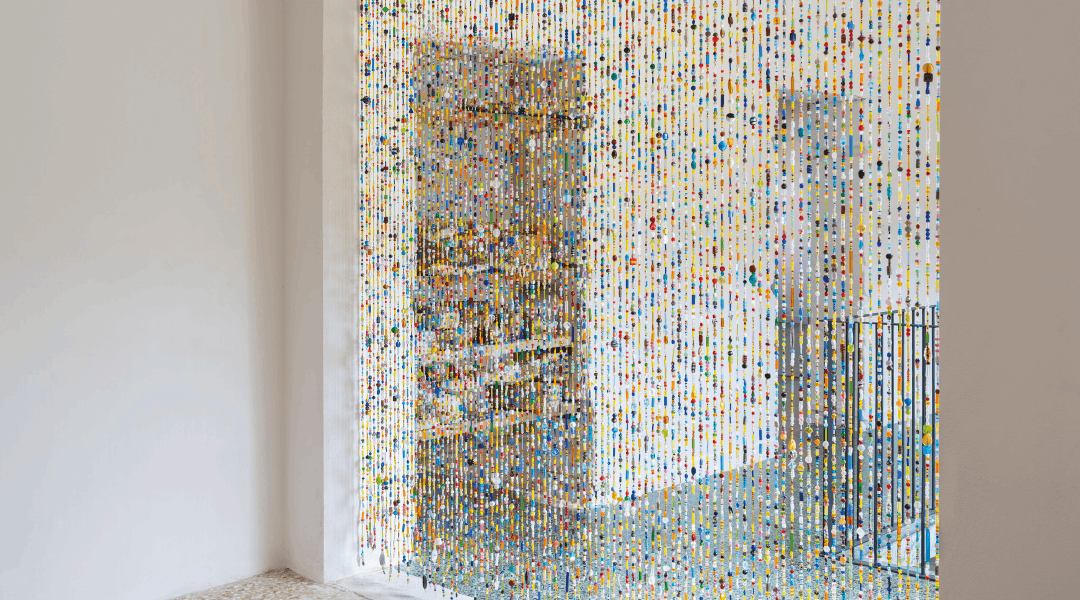
This becomes especially visible in Manuela, Margherita, Mariana, Monia, Patrizia, a beaded curtain installed between two rooms of the exhibition on the upper floor. The curtain recalls a familiar domestic object common in Mediterranean households – a threshold separating spaces while remaining permeable to air, sound and movement. It is both barrier and passage. The work was produced in collaboration with women incarcerated at the Casa di reclusione femminile on Giudecca, through the prison cooperative Banco Lotto No. 10. During her residency, Ourahmane lived directly opposite the prison; every morning she saw it from her window. The collaboration emerged from this immediate geographic proximity rather than from an abstract idea of socially engaged practice.
What makes the work compelling is precisely its refusal of symbolic overstatement. The curtain does not attempt to ‘represent’ imprisonment. Instead, it carries within itself the labour and presence of the women who made it. Their names constitute the title of the work itself. Authorship becomes distributed without disappearing entirely.
Again, Schuppli’s notion of material witnessing offers a productive way of reading the piece. The curtain records forms of labour usually excluded from visibility. The prison produces work that rarely enters public space except anonymously. Here, the object carries that labour outward, across a threshold and into another economy of attention. The curtain also functions physically rather than metaphorically. Visitors walk through it. It brushes against the body. The work insists on proximity and contact rather than distant contemplation.
Elsewhere on the upper floor, thirteen industrial wire cages filled with white hotel linen surround the viewer on all sides. The sheets are freshly washed; the smell of detergent still lingers in the air. The title is brutally descriptive: 1.3 tons of decommissioned bed linen from 200 Venetian hotels. The linen originates from Lavanderia LSG, an industrial laundry facility on the mainland in Mirano that processes textiles for Venice’s hotels and restaurants. The work exposes an infrastructure that remains largely invisible within the city’s tourist economy. Visitors encounter clean hotel rooms and immaculate bedsheets, but the enormous labour required to maintain these surfaces occurs elsewhere, outside the city’s image of itself.
At LSG, each sheet initially passes through human hands before entering automated systems of washing, drying and ironing. Workers sort textiles individually according to colour, material and condition. At the end of the process, another machine scans every sheet for tears or stains. Damaged linen is mechanically rejected and thrown from the production line into waiting cages.
Schuppli’s writing on “machinic vision”3 becomes newly resonant here. Machines register matter according to operational thresholds: defect or non-defect, usable or unusable. But what escapes this system are the slower accumulations held within the fabric itself – eighty washing cycles, bodies sleeping, illness, exhaustion, intimacy, grief. The machine identifies only structural failure; the sheets nevertheless carry histories the system cannot decode. The cages installed in the exhibition accumulated over roughly two months during the Biennale installation period. As Ourahmane remarks, “Two months of visitors equals 1.3 tons.” The equation is approximate but effective. Tourism becomes measurable not only economically but materially – as waste, weight and residue.
Yet the work’s emotional force lies elsewhere. Hotel linen occupies one of the most intimate surfaces within transient life: the place where strangers sleep, dream, recover, cry. During installation, one collaborator remarked that the pillows must be “full of tears.” Ourahmane’s dry response – “I mean, what else is a pillow for?” – avoids sentimentality without dismissing the observation entirely. The sheets remain suspended between infrastructure and intimacy. They are industrial waste and carriers of private experience simultaneously. Staple describes the linen work and the pier as inverse structures. The pier begins as sculpture and eventually becomes infrastructure; the linen begins as infrastructure and enters the gallery as sculpture. Together, the two works destabilise distinctions between utility and aesthetics, visibility and invisibility, institutional value and material function.
Throughout 5 Works, value appears less as an inherent property than as something produced by context, labour and circulation. The exhibition repeatedly asks what systems discard, conceal or overlook – and what happens when those materials are given another form of attention. Importantly, the exhibition never claims purity. Ourahmane still operates within institutional structures tied to the very economies she interrogates. The Nicoletta Fiorucci Foundation is itself part of Venice’s cultural infrastructure, and the Biennale remains the gravitational centre around which the exhibition inevitably circulates. 5 Works does not pretend to stand outside these conditions.
But that is not the point. What 5 Works makes visible is something else: that the question of how art is produced is not secondary to its meaning. Decisions about where something is made, with whom, and toward what form of usefulness shape what an artwork can say in the first place. A pier waiting for Poveglia says more about the political reality of that island than any documentary representation of it could. Craft, too – the threading of a curtain, the sorting of linen, the handling of worn textiles – appears here not as nostalgic retreat, but as a form of collective knowledge production. Against the Biennale’s logic of frictionless circulation, Ourahmane proposes a practice grounded in situatedness. The works insist that places are not interchangeable and that material carries the histories of the systems through which it moves.
Eight holes in the floor will remain when the pier is taken away. That is not a symbol. It is a condition.
[1] Susan Schuppli, Material Witness – Media, Forensic, Evidence, Cambridge: MIT Press, 2020.
[2] Ebd., S. 3.
[3] Ebd., S. 4.
